
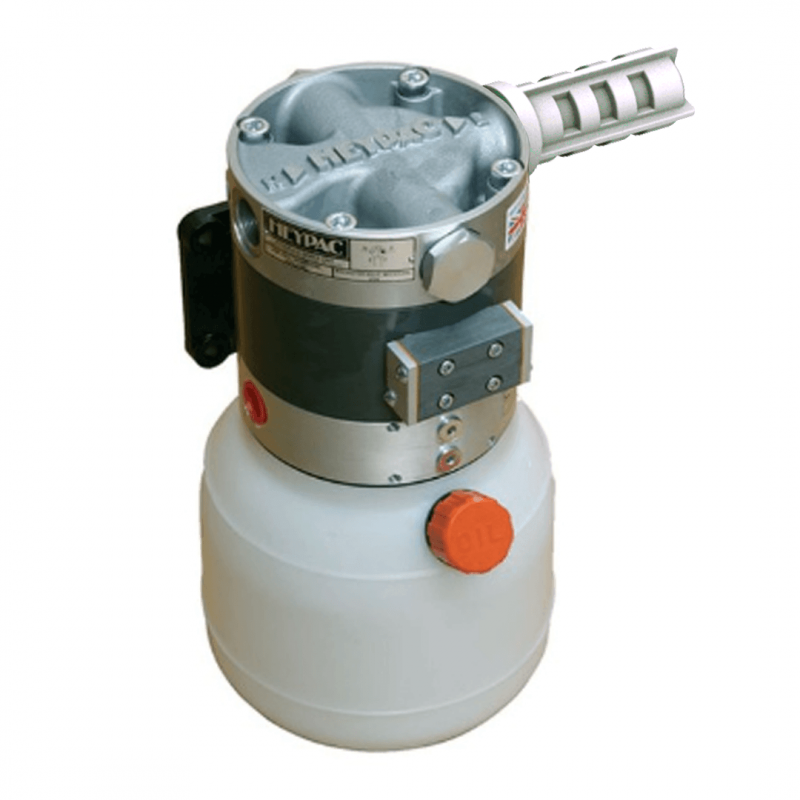

GX10 (10:1)
The HEYPAC GX10 is a double acting, free piston, compressed air driven hydraulic pump of infinitely variable delivery for general use wherever a compressed air supply is available. The pump will cycle automatically according to system demand and stall under zero flow conditions with minimal energy consumption. The output flow and pressure depend upon the intensification ratio relative to the air supply pressure and volume.
Ratio fluid:air - 10:1
P max fluid bar (psi) - 70 (1016)
Q max fluid L/min (US gpm) - 20 (5.3)
Q max average fluid L/min (US gpm) - 5.5 (1.45)
The HEYPAC GX10 is a double acting, free piston, compressed air driven hydraulic pump of infinitely variable delivery for general use wherever a compressed air supply is available. The pump will cycle automatically according to system demand and stall under zero flow conditions with minimal energy consumption. The output flow and pressure depend upon the intensification ratio relative to the air supply pressure and volume.
Ratio fluid:air - 10:1
P max fluid bar (psi) - 70 (1016)
Q max fluid L/min (US gpm) - 20 (5.3)
Q max average fluid L/min (US gpm) - 5.5 (1.45)
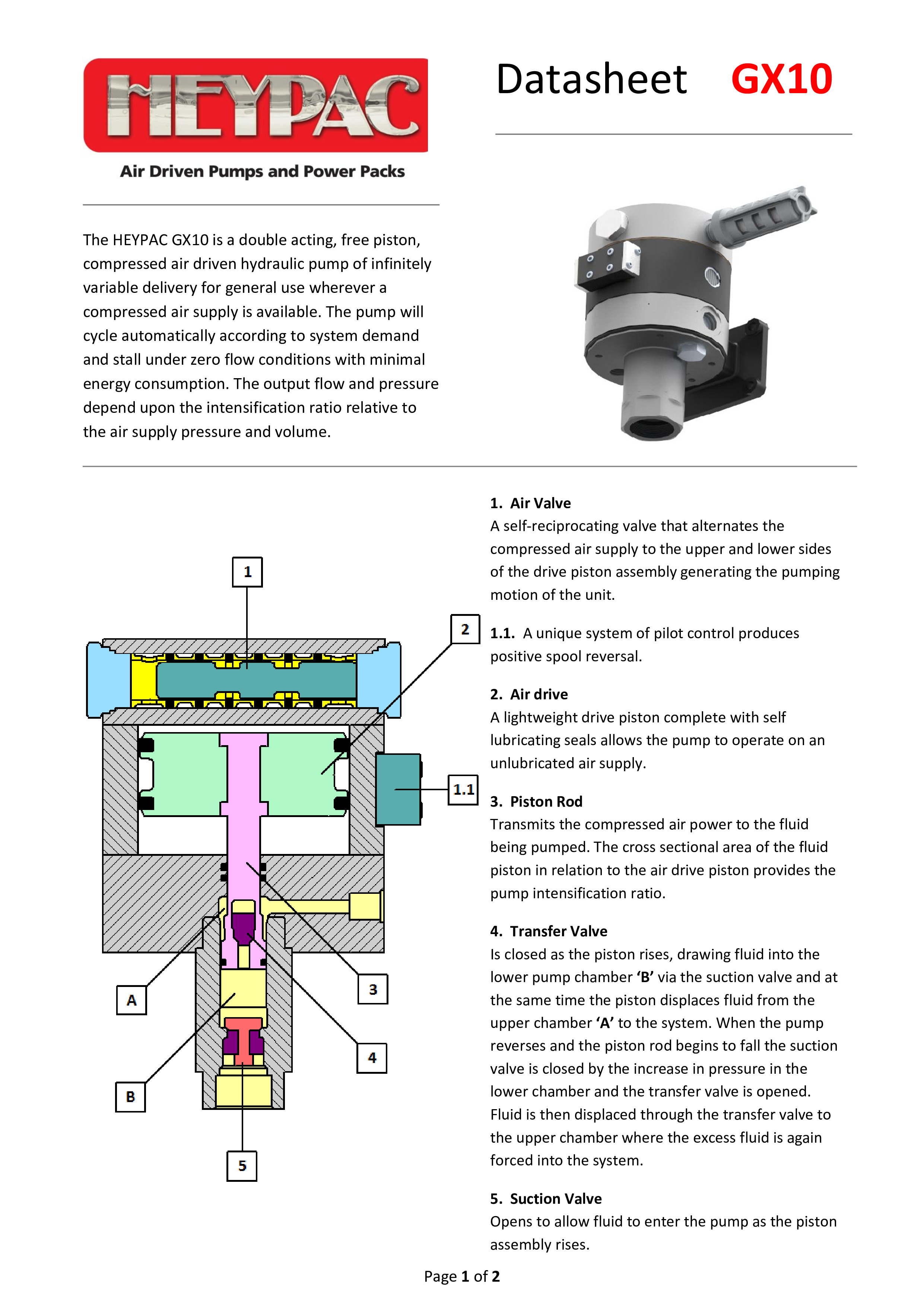
A self-reciprocating valve that alternates the compressed air supply to the upper and lower sides of the drive piston assembly generating the pumping motion of the unit. A unique system of pilot control produces positive spool reversal.
A lightweight drive piston complete with self lubricating seals allows the pump to operate on an unlubricated air supply.
A piston rod transmits the compressed air power to the fluid being pumped. The cross sectional area of the fluid piston in relation to the air drive piston provides the pump intensification ratio.
A transfer valve is closed as the piston rises, drawing fluid into the lower pump chamber ‘B’ via the suction valve and at the same time the piston displaces fluid from the upper chamber ‘A’ to the system. When the pump reverses and the piston rod begins to fall the suction valve is closed by the increase in pressure in the lower chamber and the transfer valve is opened. Fluid is then displaced through the transfer valve to the upper chamber where the excess fluid is again forced into the system.
A suction valve opens to allow fluid to enter the pump as the piston assembly rises.
| Quantity | Unit discount | You Save |
|---|